Showing posts with label conferences. Show all posts

Oct 4, 2008

PICNIC 2008 report

Open innovation at PICNIC 2008
Three sunny days in September. Thousands of sunny people, including myself, gather for a three day event at the Westerpark in Amsterdam. PICNIC 2008 has started, with a promising program filled with famous speakers, writers, businessmen and women, leaders, and interesting geeks. People who made it in business, technology, world peace, or online. Great to listen to, and above all, inspirational. A pretty expensive type of inspiration I must say, with people paying over €1200 to get a three day pass.

Fortunately, I was able to attend a special track, called Enquiring Minds, for researchers or people with an special academic interest in a relevant field. Which could be anything, considering the wide range of topics covered by th
e conference. 25 of us academic researchers, scientists, or all-round investigators gathered that beautiful morning in an old but nicely renovated building on terrain of the (late) Westergasfabriek.

Each participant was asked to explain his/her research to the others in three minutes. Some interesting topics were covered, ranging from the (the future of) arts and media, internet security, gaming and education, social software, co-evolution of knowledge production and ICT, and many more.

I explained the others that my own research aims at trying to describe and model the relationship between contributions (in online networks; i.e. blog posts) and the contributor in terms of trust, quality, and expertise. Have a look at the illustration below. It tries to depict a person who is contributing content in an online network, possibly within an organization. People, both experts and non-experts, may use (read/visit) and evaluate (rate) this content. How do expertise of the users of this content, and the type and intensity of use, can be used to profile both the contributor as well as the contribution? Quite a BIG question, I know, maybe that's the reason I have not really started it yet (need some focus?!).


Unfortunately, I have not really been at talks of people really focusing on this topic (merely acknowledging the need for research, which is good), but there was a lot of action on social media, and success factors. In my job at a small software company (doing exactly the thing I intend to research), we create social software that empowers the user to contribute, the first and most essential step needed in order to measure the mentioned relationships (between "contribution-use/users-contributor"). It is therefore very important to know what makes software social, why people use it, when a social software project fails. So that's has been the red line of my conference, and the subject of this short record of the event.

So what makes social software really social, what is successful and what is not?

I read several publications about this subject, and was interested in how these theoretical elaborations correspond with the recommendations, issues, and notes mentioned by some speakers on the conference. Some of these people were researchers, some of them were entrepreneurs who experienced success themselves. They explained trends and explained how the Internet and relating technologies offer great opportunities for more open, transparent, innovative, more efficient, and distributed ways of innovation and collaboration. And how we are moving towards a more people centered online environment, where friends in common, proximity, shared taste and objects matter. In the following sections, I deal with this in putting forward

  • criteria that concern the design of the platform or processes that empower people to contribute and make connections, but also to sustain innovation and collaboration; and
  • some examples that have been successful and explaining the reasons of their success.
These results are all derived from my experiences at PICNIC, so it will clearly lack in some respects, but I hope it gives a nice overview of the current mindset of online collaboration.

Criteria for designing the software and the processes

Software alone may be engaging and provide with incentives for people to share and connect, but some institutional mechanisms and process rules should be built in as well to sustain and improve collaboration. The last section, with examples, show how different initiatives have adopted these criteria;
  • Recognition; people want recognition for their contributions. Recognition from peers is even a more powerful incentive and mechanisms must be built in to ensure this;
  • Social object; without a social object that connects the users of the platform, you have a problem. This theme was recurrent and relates to having a shared purpose and focus;
  • Processes and tools for contributing; there are numerous tools available that can empower people to connect, contribute, and share. Still, these should be designed and named such that it truly corresponds to the ideas, wishes, and incentives of the users. This means accommodating for different types of contexts and users, and their respective motivation;
  • Different task sizes (contribute more or less), like in Open Source communities;
  • Modularity of contributions allow you to connect and combine contributions to increase the aggregate value and let people built on top of each other´s contributions;
  • Language that corresponds with the social context of the users: It has to be crystal clear what a service offers (like eBay website: Buy|Sell), what you can do on a platform, and what the added value is;
  • Involve people differently, and in different stages of the process;
  • Create different roles based on previous contributions and feedback by the community.
  • Nodal points refer to the methods and intensity of interactions of the service and user: What should trigger interaction or intervention with the user? When should you send an update, and notification, or something else? It is important only to give information the user cares about. Nodal points are the filters that are used to put forward only the relevant stuff for every occasion.
  • Policies and structures for making decisions prevent chaos, as can be seen at Wikipedia. This remains an extremely difficult challenge (Wikipedia is an ongoing design effort) for the future of collaboration.
Clearly, the above list is not extensive, but it's what I picked up by listening to the people on stage. More lessons can be drawn by looking at the various examples.

Examples of social software
We have many examples of services where there is a very specific and clear social object that connects the users, including the relevant tools (and right language used) to incentivize contributions, sharing, and creation of more value. Dopplr (frequent travelers), Nikeplus (running), and MiMoA (modern architecture and traveling) are just a few of them.

Furthermore, there are numerous projects that not so much focus on a shared social object or purpose, but offer the tools for collaboration and intend to crowdsource their communities.

  • Mechanical Turk is a service offered by Amazon to distribute tasks among a huge online community. The most important characteristic of the success of this service is the granularity of tasks, and the ability to combine tasks to make the whole larger than the sum of all parts.
  • Nederland P is a Dutch initiative for user-generated videos, an advanced YouTube, that offers a distribution channel and support for people who contribute high-quality content. Additionally, they have different roles that are based on reputation, number of subscribers, etc.
  • Aswarmofangels.com intends to create a movie for one million English pounds (1.8 million US dollars) by sourcing contributions (financial and in terms of decision-making) of a thousands of people worldwide. In this project, the focus is not on getting as many participants as possible, but slowing the participation down by focusing more on quality.
  • Openad.net is a successful crowdsourcing advertisement project that allows anyone to really make money out of open and closed assignments. An interesting aspect is that it does not intend to replace the existing marketing industry, but it rather partners with it, changing the organizational structures and vision.
  • Similarly, Sellaband.com is a successful startup in the music business that sources the musical creativity of anyone with a computer. Anyone can invest (community funding) in an artist or group in order to make this group successful and share in the revenues.
  • Blurb.com is just a nice tool to create online books and portfolios, but it also keeps the creations for sale in their online shop, with all revenues going to the creators.
  • Finally, Blender.org concerns a true open source project creating open source animation, and also advancing the open source tools and software to be able to create the animation. This reinforces each other, and the availability of support and tools contribute to the success of the initiative.
Like most of the mentioned initiatives, you can see a shared self-interest of the users, which is important to consider. This can be money (Mechanical Turk, OpenAd), but also something very different like seeing nice new architecture when you visit a city in Europe (MiMoA). This concludes the overview of ideas and lessons learned at PICNIC '08 about succesful social applications for online collaboration, innovation, and other activities. As said, literature will offer more perspectives, but it's interesting to see which things are brought forward by speakers on a innovative conference as PICNIC.

Jul 17, 2008

ED-Media 2008, Vienna > disappointing


I went to ED-Media 2008 in Vienna, presenting my paper about Delft OCW (Open Courseware >> project I graduated on @ Delft University of Technology). Clearly, I was thrilled to do that, but it kind of resulted in a disappointment. Having a handful of people listening to your story cannot be the reason for coming to such an event and travel so far. A bigger disappointment was the conference itself: it was so large, so chaotic, treating so many different subjects, and so diverging in quality, I ended up attending too many uninspiring or even disappointing presentations. Even the get-together of people was virtually non-existent: there was not really a place to hang out and get together. Moreover, the whole event was organized in three different buildings that were not too near to each other.

Overall: an uninspiring conference, and I would not go again. Although I am young, and have not attended many conferences, I have to say that all conferences, both online and offline, I have experienced in the past, were much better, and left me with many new ideas, contacts, and lots of inspiration and motivation. This one did not.

This disappointment is one, but think about all the people coming from all over the world to attend this conference. There were heaps from Asia, South-America and Australia, from the US, Mexico and South-Africa, next to European people. This costs an enormous amount of money. Let's calculate:

# of people: 1000+ people
average travel + hotel expenses: €1000 to €2500
abg. conference fee: €400

This amounts to more than 2 million euros spent collectively to attend this conference. Additionally, people get paid by their host institution to be here, meaning that another half a million to a million euros is spent: almost €3 mio for this conference (1000 persons). Can this be justified? Can all the CO2 emissions by these people be justified? As I experienced it, I would say absolutely not. It lacked interaction, inspiration, quality, and focus ...

I suggest the organization to radically change to setup of this conference, or it will die a slow death.

  • Online & Offline! Start by blending online and offline interaction, change the whole "presentation" thing: instead each person to present gets 2 minutes to introduce a discussion. Also, people need to upload a short 2 or 3 minute podcast or video to explain their talk on the conference website. Going online is a possibity as well, clearly (before, during, and after physical events). I attended 2 great online conferences organized by George Siemens, so learn from him.
  • Focus! Try to have one topic at a time, and decrease the size of the conference. You could do this per day as well.
  • Social! The most interesting discussions are held not in the presentation room, but afterwards. Support these interactions in nice rooms (not necessarily in a conference building, can be a park or coffee-room or someone's house as well), with tools and through funny, interesting, and interactive sessions &c.
These are just three ideas. A traditional conference can still be very engaging, but please don't make the same mistakes as ED-Media.

Nov 20, 2007

OpenLearn 2007 - Panel session about the future of OER (day 2)

Research Panel Toru Iiyoshi, M. S. Vijay Kumar, Andy Lane, Diana Laurillard & Stuart Lee: Opening Up Education: Removing Barriers, Fostering Participation, and Promoting Sustainability.

Currently, there seems to be an abundance of ‘open’ educational initiatives, many with the potential to radically transform the ecology and economics of education. These initiatives address various pieces of the educational landscape, including infrastructure, tools, resources, practices, and knowledge. Yet, despite the availability of tools and resources, we risk missing the ‘transformative’ opportunities from a wide range of perspectives—from improving teaching and learning in a single classroom to creating the necessary educational capacity for nation building. As a global educational community, we can benefit from a deeper understanding of how open educational tools and resources are being created and used, what local educational innovations and challenges are emerging, and how we can learn from and build upon each other’s experience and knowledge.

The panel starts with advertising a new book, published by MIT Press, which addresses the open education movement. They say it will be available on PDF, but I have not found it so far. The main pillars of openness relate to technology, content, and knowledge. Would like to see a definition of all, but since the book is still unavailable as OER, I cannot tell anything about it.

Throughout the panel discussion, a number of examples or initiatives are mentioned, such as

Keep Toolkit

The KEEP Toolkit is a set of web-based tools that help teachers, students and institutions quickly create compact and engaging knowledge representations on the Web. With the KEEP Toolkit you can:

  • select and organize teaching and learning materials.
  • prompt analysis and reflection by using templates.
  • transform materials and reflections into visually appealing and intellectually engaging representations.
  • share ideas for peer-review, assessment, and collective knowledge building.
  • simplify the technical tasks and facilitate knowledge exchange and dissemination.

LAMS International (Learning Activity Management System) (pretty similar to OU's Knowledge Mapping Tool called Compendium )

LAMS is a revolutionary new tool for designing, managing and delivering online collaborative learning activities. It provides teachers with a highly intuitive visual authoring environment for creating sequences of learning activities. These activities can include a range of individual tasks, small group work and whole class activities based on both content and collaboration.

Encorewiki

ENCORE is an Educational Network and Community for Open Resource Exchange. It is created, managed, and maintained by volunteers from within the learning sciences. Our goal is to support researchers as they exchange open source or open content materials, including relevant support documentation, constraints to implementation, and contact info. ENCORE is implemented in an enhanced wiki format, allowing for easy maintenance of small thematic spaces and collaborations. Researchers may find great materials here, and get support from colleagues to embed or intermingle those materials effectively and appropriately. Instructors or students in learning sciences courses may find and contribute reviews of papers, technologies, or other resources. Small groups can form "Collaborations" to support their efforts to exchange materials or develop new ones.

PHOEBE Pedagogic Planner

The aim of the project is to guide practitioners working in post-compulsory learning (FE, HE and ACL) in designing effective and pedagogically sound learning activities. To realise this aim, the project team proposes to:

  • Develop a prototype online planning tool that will offer users both flexible and guided paths through the planning process and enable them to access a wide range of models, research findings and examples of innovative learning designs, intended to encourage them to explore new approaches and tools in their pedagogy;
  • User-test the planning tool for functionality and usability; and
  • Investigate the feasibility of further development and the integration of the planning tool into pedagogic practice by embedding use of the planning tool into a specific context for piloting and evaluation: namely, initial practitioner training and/or continuing professional development.
The London Pedagogy Planner
The London Pedagogy Planner is a prototype for a collaborative online planning
and design tool that supports lecturers in developing, analysing and sharing
learning designs.

Andy Lane explains that the value of OER is determined and influenced by

  • Availability (how many and in what forms)
  • Accessibility (where found and by whom)
  • Level of use (degree of participation)

The influence for teaching and sharing concern the following factors:

  • Granularity of offerings (size & interdependence);
  • Resource-based learning, stand-alone;
  • Tuition and support separated from content;
  • Versioning & localization.

On the conference blog, Anesa further mentions the implications for learning:

  • Judging the appropriate mix between (i) pedagogic support (built into content), (ii) personal support – self reflection and guidance, (iii) professional support – expert reflection and guidance;
  • The importance of new social computing technologies in facilitating support and interaction;
  • Co-creation of learning experiences in a dull partnership of being a learning broker for self designed programmes;
  • Assessment only or ApL (Applied Learning) courses.

The talk ends with the question whether higher education is ready for open education, mentioning two things: inertial frames (scarcity vs abundance/pundit-pupil vs peer-peer...) and enabling structures (sense making/accountability/accreditation). An interesting panel discussion with some informative slides.

OpenLearn 2007 - OLI: accelerated learning with @ CMU's OLI (day 2)

Candice Thille and Joel Smith from Carnegie Mellon's Open Learning Initiative, explained their very interesting findings on the OLI's impact on learning. They measured the effectiveness of OLI statistics course in accelerating learning, and interestingly: students learn faster and better! And they are able to articulate in their answers, not just calculate them in statistical terms. I have discussed OLI more from a sustainability perspective here, but the approach of impact on learning is very interesting. And the findings even more so! Very promising.


A primary goal of the Open Learning Initiative (OLI) at Carnegie Mellon is to provide free access to high quality post-secondary courses (i.e., similar to those taught at Carnegie Mellon). Previous evaluations of the effectiveness of OLI courses have shown that our online courses teach students as effectively as existing instructor-led courses. Two such studies have found this result for the OLI-Statistics course. This report describes our current study of OLI-Statistics in which we are evaluating the accelerated learning hypothesis – that learners can learn a semester’s material in half the time, while still achieving the same or better learning outcomes.


The courses offered by CMU OLI are, as I have explained before, not ordinary open courseware materials. They mention the following about the learning material:

  • based on learning theories
  • use driven design
  • transforming instruction, not transposing it
  • scaffolded
  • predict: immediate feedback through AI systems and cognitive tutors
  • (expensive to make)

There are four feedback loops based on student learning data; science of learning, instructor activities, course design, student performance.. The initial assumption that the open courses would not be used at university appeared to be wrong: they were better than the normal courses, and quickly became a prototype to be used. The interesting thing is the research done on the learning outcome of students following the normal course, and students following the online course.

  • Statistical literacy: The first research was set up between two groups of students: one group did the online version, and teachers were not allowed to guide them, only answering their questions once a week. The second group did the classroom version, and interacted in a classroom setting once or twice a week. One of the first outcomes was that there was not a statistical difference between the groups online and classroom learners.... but the application of the knowledge in real settings, or answering more applied questions was done better by the students doing the online version.
  • Better and faster: The second research was done with a slight but important difference: the online students were allowed to interact in-depth with teachers twice a week. They would normally have prepared the questions, and had one or two hours of interacting with the teacher. Regarding the experience, both teacher (great! quality time with students!) and student (fantastic! I am learning!) were very contended. Concerning the outcomes, even better results were presented: the students were not only able to do it twice as fast, but their results on tests were significantly better as well.

Nov 19, 2007

OpenLearn 2007 - From Boot Camp to Holiday Camp? (day 2)

Patrick McAndrew had a nice presentation called: From Boot Camp to Holiday Camp? Some issues around openness, Web 2.0, and learning.

"Open Educational Resources were initially seen as a way to exchange and exploit content. For example, the MIT OCW material can be adapted as acurriculum plan and set of resources for use in another institution.

What has also emerged is that there is also direct use of the material by learners. OpenLearn has a configuration that more clearly reflects this by offering a ‘LearningSpace’ designed to allow users to pick units to work with and use them within their personalised learning environments and alongside other learners. However, these learners will not be part of any registered course, won’t be focused on compulsory assignments and will not get a qualification at the end of their work.

The ‘Boot Camp’ elements of education, where learners are organised and coerced into performing necessary learning practices, has therefore disappeared. So a question is whether these elements should be replaced with features that are more in line with a ‘Holiday Camp’, where learning is loosely structured and ‘fun’, but is still relevant and valuable. This talk will explore these metaphors as lenses that can help us to design for learning practices that share their landscape with huge-scale media-rich interaction and radical publishing in the context of open technologies and Web 2.0."

Patrick explained motivation using the metaphors of carrots and sticks. Carrots are teasers for students to perform better, such as grades and diplomas.. sticks are a metaphor for punishments to threaten students used for increasing their performance. These are the principle motivators for learning in schools today. With freely available learning materials, openness enables another learning driven by motivation and enjoyment. There is a transition going on from straightforward to open learning: abundant choice and driven by motivation and enjoyment.


We are all part of the web, which allows democratic and collaborative media creation, sharing and consumption. But how do we come from interest to learning? Patrick mentions Confucius, who said:
I hear and I forget,
I see and I remember
I do and I understand
a long time ago. The web allows to actually do (see keynote JSB). But in order to embrace it, we need to reconceptualize learning.

Formal education has the following motivation factors:
  • Assignment deadlines
  • Examinations
  • Tutors who call
  • Qualifications
  • Progression
  • Peer approval
Learning at OpenLearn is motivated by
  • Professional development
  • Interest
  • Hobby
  • Job progress
  • Job change
We need to focus on supporting learning for fun, and Patrick mentions the rise of learning clubs. Tools are important for this, and the term ambient learning design is brought up, with examples of learning tools, such as digital dialogue games as the InterLoc tool. This brings in the issue of scaffolding, something that John Seely Brown should be approached with care, because kids nowadays want to create everything themselves. We need to find out from an anthropological angle to find out what is going on between the students in these dialogue tools as he raises the issue of World of Warcraft where he thinks a scaffolding tool would be laughed at. He says that we should be careful with building mental models or projectories.

OpenLearn 2007 - Learning Design as a framework for supporting the design and reuse of OER (day 2)

Somewhat interesting presentation which describes how adopting a learning design methodology may provide a vehicle for enabling better design and reuse of Open Educational Resources (OERs).

Design is creative and messy... a tool such as the Compendium tool, which is easy to use, has good support and documentation, is flexible and adaptable, and enables linkages to be made between entities, may be able to provide creators of learning content with support. It is a means of representing design and facilitating reuse. It can be used at the start of design process, to balance a set of activities, and to critically deconstruct sets of activities. The benefits that were mentioned by the people using it for learning design were quite positive, mentioning thinking differently about the learning design, visualization, communication, collaboration. Drawbacks are level of granularity (low), the trade-off time investment/benefit, and novice vs. expert uses. I have installed and used the free tool a year ago, but I did not like it that much. There is vizualization, yes, but it is not great. Quite some space left for improvements.

The slides:

Nov 8, 2007

OpenLearn 2007 - Learner generated contexts (day 2)

The concept of learner generated contexts (LGCs), without knowing exactly what it was, directly interested me. Many discussions are about user-generated content, distributed development of OER, etc. but, although acknowledging the importance of the learning process, little focus has been on learner generated contexts. The first session after John Seely Brown's inspiring keynote speech focused on LGCs, which was defined as

"a context created by people interacting together with a common, self-defined or negotiated learning goal. The key aspect of Learner Generated Contexts is that they are generated through the enterprise of those who would previously have been consumers in a context created for them."
The emphasis on contexts is clear: learning is a social process occurring across a continuum of contexts, and learning must be “fit for context”. The generation of context is characterised as an action on tools where a user actively selects, appropriates and implements learning solutions to meet their own needs (Bakardjieva, 2005). In their paper they introduce the concept as follows;
The rapid increase in the variety and availability of resources and tools that enable people to easily create and publish their own materials as well as to access those created by others extends the capacity for learning context creation beyond teachers, academics, designers and policy makers. It also challenges our existing pedagogies. Another challenge is that of finding ways in which technology can support learners to effectively create their own learning contexts and how this contributes to sustainability of open education.
The following are key issues emerging from this concept:
  • learners as creators not consumers
    • learning: from regulation and practice towards participation
    • co-configuration, co-creation, co-design of learning
    • changing roles of educational participants or “agile intermediaries”
  • pedagogy (teaching of children), andragogy (teaching of adults), heutagogy (self-determined learning)
  • needs or questions which enable new relevant learning contexts
  • learning design allowing learners to create their own context or space
    • learner needs to participate in the control of how their environment feels and works; however,
    • the ‘preferred’ and ‘best’ learning context may not be the same: understanding purpose in learning design
    • environment as physical, social and cognitive
    • the role of narrative in learning
Changes in learning and teaching should not start with embracing new technologies. Rather it is about contextualising learning first before you support it with technology. Still, these ideas have their roots in the affordances and potentials of a range of disruptive technologies and practice; web 2.0 and participative media, mobile learning, learning design and learning space design. John Seely Brown's participative architecture (or ecosystem) was brought forward here again, but there are a lot of obstacles/issues, such as roles, expertise, knowledge, pedagogy, accreditation, power, technology, participation and democracy.

LCG glasses for curriculum, organization, and administration
An "Ecology of Resources" model of context was depicted with the following characteristics, viewed with LGC glasses;
  • Knowledge and Curriculum
    • learners have agency and are pro-active in identifying a social learning need and/or a knowledge gap;
    • learners work is published and accessible outside of institution/school and 'visitors' or experts are brought into the dialogue via physical meetings or virtual spaces;
    • learners are generating content and meta content that is recognised by others, thus validating the organisation of their contextually generated knowledge; and
    • learners can understand the relevance of their knowledge gap to the rest of their lives, beyond their current environment.
  • Resources and Administration
    • available to learners to appropriate them to meet their needs; and
    • learners can understand the functionalities and affordances of the resources that make up their environment and how these match to their recognition production gap.
  • Environment and its Organisation
    • loose frameworks and freedom of choice; and
    • learner ability to understand the elements that make up their environment in terms of multiple perspectives, such as physical, social and communication so that they can marshall them into symbiotic relationships. This activity might operate from scratch or may simply mean the tailoring of existing relationships and interactions.
  • Learning process
    • personally meaningful for the learners;
    • facilitated in some way by their environment; and
    • ever widening boundaries of dialogue with and between multiple participants across multiple locations.
World of Warcraft
John Seely Brown argued that World of Warcraft fosters the creation of Learner Generated Contexts, and other, more specific educational games might be even better appropriate for fostering the creation of LGCs. He made the notions of considering the dialectic between institution and learning, and the vocabulary which impedes considering certain environments as learning environments. I remember something I read online, about the work processes within the IT company Geek Squad in the USA. An IT manager in that company tried to implement a certain technology to make the employees collaborate better, but concluded that they already found their own platform and context for collaboration: World of Warcraft.

And what about the relation with OER?
Maybe we will will see a shift from OER to OEC (Open Educational Contexts). I see great potential in learner generated contexts and open learning designs that can be remixed by the learner. I understand the concept as something that lets the learner free to make his own learning environment, solo or in collaboration with others. This requires quite a significant change in institutional design of current educational institutions, but one that may be needed. Of course, students may create their own content, but I think that in a world where so many different opportunities for learning exist, an institution cannot define the exact learning environment or context for each learner. A learner may find his/her own, but to what extent are guidance or formal rules needed? What about tacit knowledge? I think an important issue to address in creating a LGC relates to content: how can relevancy be determined and the right resources be linked, and in that way make a learning context, consisting of many different people, types of content and media, possibly environments, etc...

I hope that this research will provide some answers on these questions, because it might be very relevant for decisions on policies about learning and learning environments within institutions.

Some links

Nov 7, 2007

OpenLearn 2007 - Keynote John Seely Brown (day 2)

The second day of the OpenLearn conference started with a captivating talk by John Seely Brown, building on the report on OER he wrote with Daniel Atkins and Allen Hammond. I have discussed this report in detail in a previous blogpost, but the talk still provided some new insights and interesting views on learning. His engaging and natural way of talking, enthusiasm, nicely illustrated presentation and lively examples kept me more than awake.

From Descartes to John Seely Brown
JSB explained how a shift is occuring from the Cartesian "I think, therefore I am" towards "I participate, therefore I am" to socially construct understanding. I must say I like this, because if you take "I am" as something that has to do with identity, then just thinking is not enough, since you need to identify and you need others to do this. There should be less emphasis on knowledge transfer, but more on learning that occurs constantly (such as learning to talk for children). He proposes the Participatory Architecture he has described in his report, where "work in progress" is made public. He makes the connection with an architecture studio, where a similar way of working exists, and suggests that this is a powerful learning environment.

Tinkering
JSB introduced the keyword of his speech, and I think also of the conference, where participants repeated it with quite a bit of persistence: TINKERING. With tinkering he means exploring, finding out, creating meaning, etc. with all different kinds of tools and possibly in collaboration with others. According to him, the traditional flow of learning should be reversed, which means a more engaging "learning to be" (tacit) towards "learning about" (explicit). The Open Participatory Learning Infrastructure, now called OPLE (E = Ecosystem) fosters this type of learning. It should be noted that his view on the world is defined by his experiences as a tinkerer himself, and maybe not every person is a tinkerer. He names a number of interesting examples of tinkering, which forms the foundation for tacit knowledge (Michael Polanyi ). Examples include coders in Open Source communities, kids playing online games, mash-ups and remixing, LEGO, Your Truman Show.

OPLI
In report he co-authored for the Hewlett Foundation the OPLI (now OPLE) is defined as a

"decentralized environment that (1) permits distributed participatory learning; (2) provides incentives for participation (provisioning of open resources, creating specific learning environments, evaluation) at all levels; and (3) encourages cross-boundary and cross cultural learning."
It consists of tools, content, and activities (with constant feedback loops), and is a place where knowledge creation, learning, and mentoring are intertwined. He emphasized four main trends in his speech, which more or less sum up the OPLE.
  • eScience
    • An example is given about the Faulkes Telescope Academy, where students run real experiments with a master and then pool and analyse their results. This works better as the students were participating in real research and discovering real results for themselves and sharing them with the wider group. This is also an example of professionals and amateurs working alongside each other.
  • eHumanities
    • The Decameron web is another example that shows what real scholarship, or "learning to be", in a certain field means. This is a perfect example of "the Long Tail" of educational resources (no library space needed).
  • Web 2.0
    • A fundamental trend from scarcity to abundance, and a culture of participation & co-creation. People create meaning by what they produce and other build on - a remix, open source culture, where we can turn anyone into being both a teacher and a learner.
  • Open Educational Resources
    • Just resources is not enough: there should be a focus on (student-)participation.
    • The Long Tail of learning (resources) are too expensive for universities to make or foster. A culture of abundance, and a Long Tail of OER and other online resources, will enable personalized learning. Universities should not build their business models on scarcity of resources!
Final points
JSB ends his interesting talk with three points
  1. Active blending learning and researching, for example eScience.
  2. From stocks to flows: more on-demand and personalized learning.
  3. Creation becomes re-creation: we should move towards a culture of learning learning. In the end, this would create real sustainability with learning communities that thrive on participatory lifelong learning.
The talk was engaging and stimulating, and summed up nice the somewhat radical view on how learning and education should occur, and which direction educational institutions should take.

OpenLearn 2007 - Learning the open source way (day 1)

Ellen Sjoer and I went to the OpenLearn conference last week in Milton Keynes, England. The conference about open content in education had four main themes;

  • Research agenda
    • Models of informal learning in the world of open education.
    • Cross-cultural issues of open education.
    • Research methods for online research of informal learning.
  • Sustainability
    • Sustainability models for open educational resources.
    • Production approaches and costs for open educational resources.
    • Methods for embedding open content in education.
  • User experience
    • User experience with open content.
    • Case studies illustrating user models.
    • Accessibility of open education.
  • Software and tools
    • Tools and software supporting open education.
    • Social software for open education.
    • Mobile technologies in open education.
This post will treat the experiences of the first day: a FLOSScom meeting about the principles of open source, and how these can be applied in a formal educational context.

With some delay Ellen and I arrived at the session that concerned the question whether open source (OS) principles can be applied in educational settings, specifically for the creation of open content. An interesting topic introduced by researcher Andreas Meiszner of FLOSSCom. FLOSS means Free-Libre Open Source Software. His research focuses on
  1. Identification of factors that contribute to successful knowledge construction in informal learning communities, such as the FLOSS communities.
  2. Analysis of the effectiveness of FLOSS-like learning communities in a formal educational setting.
  3. Provision of case studies, scenarios and guidelines for teachers and decision-makers on how to successfully embed such learning communities within formal educational environments to enhance student progression, retention and achievement.
  4. Evaluation of the project and dissemination of the results of the project to the wider community.
Andreas prepared two presentations to support this workshop. The first one is a basic overview on learning related aspects within open source software communities and the second one tries to model FLOSS-like learning scenarios for educational settings. In explaining the characteristics of learning in OS communities and formal education, he mentions the following;

OS communities
Formal education
  • Content is dynamic
  • Learning resources are manyfold
  • Users are also active creators
  • Support and learning resources are closely connected
  • Open and transparent structures foster reuse and discourse, but also improvement and evolutionary growth
  • Existence of a wide range of possible activities to engage at around the core product
  • Self-learning and learning from what others did are the predominant of learning
  • Materials are the product of a few authors, little contribution from other people
  • Basic software usage and experience
  • Infrequent releases, feedback seldom considered, no continuous development cycle
  • Distribution depends on publishers
  • Prior learning outcomes and processes are not systematically available (in OS communities these are mailing lists, forums)
  • No community involved
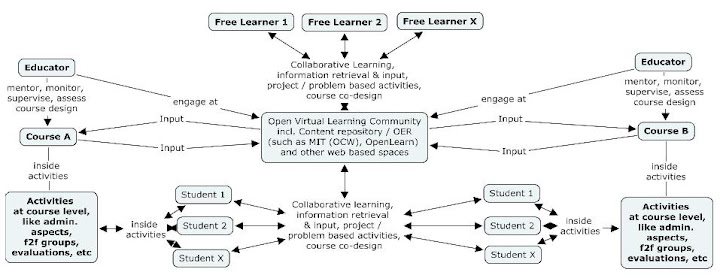
Andreas made a very interesting overview of applying FLOSS principles in a formal educational environment and explains how such an environment will overcome some of the mentioned problems:

FLOSS learning in formal education
Learning from OER today
  • Students, teachers and free learners use the same web spaces and are connected in an organized way
  • Teachers’ output is made available in open repositories (e.g. OER)
  • Students’ outputs and activities become part of the course or make a new learning resource
  • Students’ learning processes are recorded and can be found online
  • Students’ support is divided into formal support (usually not recorded) and informal support at the web (recorded) within known established and mature support environments
  • There is re-use, peer-review, collaborative content production, communities & evolutionary growth
  • Repositories of OER are created, not learning communities
  • Content is defined and produces in the traditional way
  • Content is static, not manifold and rarely updated
  • Formal students do not directly engage with neither OER or external students or free learners
  • Learning outcomes and processes do not become part of something (course, learning resource, product, etc)
  • Support and learning resources are not connected
  • There is no concern for motivations and activities to attract free learners to become active contributors

The discussion touched upon different relevant issues:
  • Quality assurance and evaluation
    (for both content and learner). Some emphasized the high importance of experts, and doubted that an anarchistic OS environment for learning would enhance learning and learning resources. Others explained that
    • a faster feedback loop on resources and questions/problems improves quality;
    • quality depends on the context of learning, hence cannot be determined for others;
    • advanced rating and tagging mechanisms can be implemented to overcome some of these perceived issues;
    • there is a social element of learning embedded in OS communities;
    • experts (old foxes) and leaders play an important role in OS communities as well, next to roles and task assignment. (Connexions research).
  • The need to meet a given curriculum, setting ground rules
    • Making a metalayer or learning contexts on how to make resources and combine them, focusing less on content.
  • Cultural resistance to change, and community development aspects
    • Culture of learning versus accreditation. Next generation university: exam-only + external bodies for learning?
    • Interface management is crucial in creating learning objects in an open source way :: "Modularity reduces the costs of coordination, but is only possible when the interfaces between the modules are clearly defined." (Understanding Open Source Communities, van Wendel de Joode 2005, p.85)
  • Difference between open source and (formal) education
    • Richard Heller said that there is a foundational difference between OS and OER.
      Within OS is the software the end, but for education the learning process is considered more important. OER cannot be considered the end, rather the education process that surrounds it. I am not sure whether I agree with it, and not because I think that learning objects or resources are more important than the process. Rather, I think that software creation in OS communities is not an end either. People and machines in this respect can be treated in the same way: software feeds the machine to work better, educational resources feed the human machine to function better in society.
  • Getting passionate users in an OER community, like within OS communities
    • Andreas explained the so-called "Onion Model", with 2% of the community core programmers making more than half of the code (OER: educators), and the rest of the code (45%) being made by passionate users. A third group is formed by the passive users. Andreas argues that within OER initiatives we miss this group of passionate users. We have 2% educators responsible for the content, but no tools, manuals, incentives for the users of the content to become active and passionate
      contributors as well.