
An image I found in a report of a friend who did an investigation on open innovation. Innovation or creativity can be initiated or improved by using such structured processes.
Showing posts with label open innovation. Show all posts
Showing posts with label open innovation. Show all posts
Dec 5, 2008
Opportunity development process

Nov 20, 2008
The proof for peer production
Mozilla, or as my father called it "Mozzarella", is an open source project that allows anyone to contribute. The nice thing about the browser is not just that people can contribute code to the browser, but they can develop applications that run on the browser (Facebook, <b>not open source,</b> does the same for its social network). Today, Mozilla corporation announced that more than 1 billion addons have been downloaded by its users. I am not really surprised by this, because I could not go without FF addons, it is one of the main reasons I use this browser (rather than Chrome or Opera). I might post another blog with my favourite addons, including the Clipmarks addon I use for posting this message.
 clipped from www.readwriteweb.com clipped from www.readwriteweb.com
|
 Mozilla today
 Oct 4, 2008
PICNIC 2008 report
Open innovation at PICNIC 2008
Three sunny days in September. Thousands of sunny people, including myself, gather for a three day event at the Westerpark in Amsterdam. PICNIC 2008 has started, with a promising program filled with famous speakers, writers, businessmen and women, leaders, and interesting geeks. People who made it in business, technology, world peace, or online. Great to listen to, and above all, inspirational. A pretty expensive type of inspiration I must say, with people paying over €1200 to get a three day pass.
Fortunately, I was able to attend a special track, called Enquiring Minds, for researchers or people with an special academic interest in a relevant field. Which could be anything, considering the wide range of topics covered by the conference. 25 of us academic researchers, scientists, or all-round investigators gathered that beautiful morning in an old but nicely renovated building on terrain of the (late) Westergasfabriek.
Each participant was asked to explain his/her research to the others in three minutes. Some interesting topics were covered, ranging from the (the future of) arts and media, internet security, gaming and education, social software, co-evolution of knowledge production and ICT, and many more.
I explained the others that my own research aims at trying to describe and model the relationship between contributions (in online networks; i.e. blog posts) and the contributor in terms of trust, quality, and expertise. Have a look at the illustration below. It tries to depict a person who is contributing content in an online network, possibly within an organization. People, both experts and non-experts, may use (read/visit) and evaluate (rate) this content. How do expertise of the users of this content, and the type and intensity of use, can be used to profile both the contributor as well as the contribution? Quite a BIG question, I know, maybe that's the reason I have not really started it yet (need some focus?!).
Unfortunately, I have not really been at talks of people really focusing on this topic (merely acknowledging the need for research, which is good), but there was a lot of action on social media, and success factors. In my job at a small software company (doing exactly the thing I intend to research), we create social software that empowers the user to contribute, the first and most essential step needed in order to measure the mentioned relationships (between "contribution-use/users-contributor"). It is therefore very important to know what makes software social, why people use it, when a social software project fails. So that's has been the red line of my conference, and the subject of this short record of the event.
So what makes social software really social, what is successful and what is not?
I read several publications about this subject, and was interested in how these theoretical elaborations correspond with the recommendations, issues, and notes mentioned by some speakers on the conference. Some of these people were researchers, some of them were entrepreneurs who experienced success themselves. They explained trends and explained how the Internet and relating technologies offer great opportunities for more open, transparent, innovative, more efficient, and distributed ways of innovation and collaboration. And how we are moving towards a more people centered online environment, where friends in common, proximity, shared taste and objects matter. In the following sections, I deal with this in putting forward
- criteria that concern the design of the platform or processes that empower people to contribute and make connections, but also to sustain innovation and collaboration; and
- some examples that have been successful and explaining the reasons of their success.
Criteria for designing the software and the processes
Software alone may be engaging and provide with incentives for people to share and connect, but some institutional mechanisms and process rules should be built in as well to sustain and improve collaboration. The last section, with examples, show how different initiatives have adopted these criteria;
- Recognition; people want recognition for their contributions. Recognition from peers is even a more powerful incentive and mechanisms must be built in to ensure this;
- Social object; without a social object that connects the users of the platform, you have a problem. This theme was recurrent and relates to having a shared purpose and focus;
- Processes and tools for contributing; there are numerous tools available that can empower people to connect, contribute, and share. Still, these should be designed and named such that it truly corresponds to the ideas, wishes, and incentives of the users. This means accommodating for different types of contexts and users, and their respective motivation;
- Different task sizes (contribute more or less), like in Open Source communities;
- Modularity of contributions allow you to connect and combine contributions to increase the aggregate value and let people built on top of each other´s contributions;
- Language that corresponds with the social context of the users: It has to be crystal clear what a service offers (like eBay website: Buy|Sell), what you can do on a platform, and what the added value is;
- Involve people differently, and in different stages of the process;
- Create different roles based on previous contributions and feedback by the community.
- Nodal points refer to the methods and intensity of interactions of the service and user: What should trigger interaction or intervention with the user? When should you send an update, and notification, or something else? It is important only to give information the user cares about. Nodal points are the filters that are used to put forward only the relevant stuff for every occasion.
- Policies and structures for making decisions prevent chaos, as can be seen at Wikipedia. This remains an extremely difficult challenge (Wikipedia is an ongoing design effort) for the future of collaboration.
Examples of social software
We have many examples of services where there is a very specific and clear social object that connects the users, including the relevant tools (and right language used) to incentivize contributions, sharing, and creation of more value. Dopplr (frequent travelers), Nikeplus (running), and MiMoA (modern architecture and traveling) are just a few of them.
Furthermore, there are numerous projects that not so much focus on a shared social object or purpose, but offer the tools for collaboration and intend to crowdsource their communities.
- Mechanical Turk is a service offered by Amazon to distribute tasks among a huge online community. The most important characteristic of the success of this service is the granularity of tasks, and the ability to combine tasks to make the whole larger than the sum of all parts.
- Nederland P is a Dutch initiative for user-generated videos, an advanced YouTube, that offers a distribution channel and support for people who contribute high-quality content. Additionally, they have different roles that are based on reputation, number of subscribers, etc.
- Aswarmofangels.com intends to create a movie for one million English pounds (1.8 million US dollars) by sourcing contributions (financial and in terms of decision-making) of a thousands of people worldwide. In this project, the focus is not on getting as many participants as possible, but slowing the participation down by focusing more on quality.
- Openad.net is a successful crowdsourcing advertisement project that allows anyone to really make money out of open and closed assignments. An interesting aspect is that it does not intend to replace the existing marketing industry, but it rather partners with it, changing the organizational structures and vision.
- Similarly, Sellaband.com is a successful startup in the music business that sources the musical creativity of anyone with a computer. Anyone can invest (community funding) in an artist or group in order to make this group successful and share in the revenues.
- Blurb.com is just a nice tool to create online books and portfolios, but it also keeps the creations for sale in their online shop, with all revenues going to the creators.
- Finally, Blender.org concerns a true open source project creating open source animation, and also advancing the open source tools and software to be able to create the animation. This reinforces each other, and the availability of support and tools contribute to the success of the initiative.
Dec 28, 2007
Democratizing Innovation.. 3D printing
Amazing technology, wonder what the possibilities are.. Now these printers are not so functional, and rather expensive ($3000). But in 10 years...?
Pretty cool that this guy makes the software open source as well.
Nov 13, 2007
OpenEd week 13 - The OpenCourseWars

2005 – 2012: The OpenCourseWars
The initial beauty of open education quite rapidly turns grey with problems of the NC license again, with public opinion turning against OCW. Problems with defining Non-Commercial quickly becomes not only a theoretical problem, but a real problem indeed:The publishers, clearly not very happy with the whole open education movement, follow with a brilliant strategy attacking the NC clause, and win in court: the NC clause is struck down, and all the content that used to be licensed only for non-commercial use, suddenly became available for commercial use. After this apparent success by the publishers, they could now use and commercially distribute the OCW content, which they did. Still, they would be obliged to mention the Creative Commons license, and share the (now commercial) content under the same open license (Share-Alike). Surprisingly, they even ignored this clause, and they did not Share-Alike, because the publishers thought they could attack and bring down the SA clause as well... but to no avail, and to their own demise.Creative Commons’ own publicly posted discussion draft of Proposed Best Practice Guidelines to Clarify the Meaning of Non-Commercial in the Creative Commons Licenses suggested we approach the meaning of the term noncommercial from the “Nature of the User”. To put it simply, the guidelines asked if the would-be user of the noncommercially-licensed material was an individual or non-profit institution. If so, everything was kosher. If not (if the would-be user was a for-profit company), then they were not permitted to use materials. Seems very straightforward, right? MIT OCW, however, saw things in a very different way. They provided their own definition of Noncommercial, in which they said, “Determination of commercial vs. non-commercial purpose is based on the use, not the user”, and that as long as you’re not trying to make money off of their materials, they were cool with whatever else you did.
So on the one hand you had Creative Commons suggesting that Noncommercial should be determined by the nature of the user, and on the other hand you had MIT OCW defining the very same clause of the very same license in the completely opposite way. I had known about this problem for years, and had email discussions with a number of people at both Creative Commons and MIT hoping to get it fixed. But the problem was extremely thorny politically, and nothing had happened yet.
This lack of judgment started a great new movement in open education, led by students, who happily participated in creating a vast infrastructure of open content. But... another licensing war mounted the surface: CC versus GFDL. This was settled as well, finally, and then there was the dawn of a beautiful period in open education: power to the people, in this case students. David uses the following quote to explain that younger university faculty started to ignore the standard opencoursewares altogether in favor of working:
Putting professors’ lecture notes and things on an university website where students can’t trib test questions and photos and things makes about as much sense as using email. It’s for old people who just don’t get it. I mean, even this eBook reader thing I just got from my sister (who finally graduated, by the way) is pointless. Why would anyone use a device that won’t let you tribTribbing is contributing, as you might expect. On the other hand, the opencoursewares are R/O, or read-only, and is "associated with the kind of “authority” young folks want to rebel against, and embodies an entire generation’s frustration with top-down, un-democratic, un-participatory approaches generally."
Following the pandemonium concerning licensing, opencoursewares, and learner participation, a new kind of university emerged: the competency-based university, where students only had to pass a test or exam to be accredited. One of the first universities adopting this model, a traditional online university, started an IBM/Linux like collaboration with the largest site for open content educational materials, creating an enormous synergy; increasing the quality of learning materials, and cost savings for the university itself. A spin-off of the university provided an additional service, where students could approach experts worldwide through Skype for personalized support, paying a certain fee. This service initiated a kind of e-lance economy in itself, because anyone could be an expert. These experts, most of them students, were not inclined to give bad service, because they would be rated by the user, and bad ratings lowered their future chance on flexible employment.
NB.Despite the beauty of the above depicted future, I have an extra note about the accreditation-only model: it will only be valuable if the diploma itself represents value, which depends on the type of assessment: if it is personal, competency-based, and practical, I think these universities might have a chance for survival. If they don't, and assess students with normal exams and tests, I see little future in this model.
An important quote in the postlude represents the most important difficulty with current OCW initiatives:
Embracing the trib culture, David says, opens up opportunities for new business models and new ways of learning, something I totally agree with. He created a very interesting future history of open educational resources, going through different transitions, mentioning important problems in licensing, student contribution, and describing great opportunities in learning, competition, and creating value in society. In all, the end depicts a very similar look on the future as I have described earlier (and just posted on this blog), about "How I want to wake up one day...".Generally speaking, OCWs were difficult-to-sustain R/O endeavors that relied on relatively small numbers of university employees and outside funding. As important as they were, they could never scale and were unsustainable in the ways their original funders wanted them to be. On the other hand, OER projects were generally democratic remix projects that lived and died on the quality of the trib’ing.
Criticisms and additions
I will provide some additions and criticisms to the very interesting view on the future of open education, by using the same narrating style David uses.
The shift from a teacher-centered university, with professors standing on a stage and transferring knowledge, towards a learner-centered university happened slowly but steadily, when experts are no longer able to transfer knowledge any better than high quality video and multimedia learning materials. In addition, traditional classes turned into some kind of open (and closed) discussion groups in an online virtual world, and face-to-face interaction started to happen in smaller groups for brainstorming and praxis, and large groups in conference like gatherings, organized by students.
Decentralization started to spread into all facets of the learning process, including curricula: students were more and more able to follow learning tracks personalized for them. When the point was reached that faculty and university educators were no longer able to make personalized tracks for each and every one of them, this process is finally decentralized and students were able to make their own learning profile and track, changing and adapting it along the way. Any student could make any track he or she wanted, by aggregating courses, and finding experts to help him (gain knowledge, get employed). These experts were initially paid by universities to do this, but later on another mechanism started to mount, replacing this financial incentive with another one. Lifelong learners got involved in this process, and learning networks came into existence where different facets of society are represented: industry, university, and lifelong learners (including students as we know them today).
Facing quite some opposition, the replacement of normal faculty by these learning networks (ranging from a few to thousands of people) took some time. Learning networks gradually overtook the role assumed for so long by universities: they started to accredit the people in their networks, and were responsible for creating meaningful resources for learning, including challenges and prize competitions, something that became very popular in these learning networks. Universities changed their business models, and flexibly offered hardware (rooms, technology, labs, etc.) and services (creating high-quality materials from bare content, catering, human resource management, etc.) to these learning networks.
New diplomas and certificates were popping up everywhere online, and it seemed that any group was able to give out diplomas, creating quite a disturbance and call for the past. It was not long before a standard appeared, a kind of Netiquette, applying to these diplomas. Diplomas were still given in abundance, but the information relevant to the diplomas were instantly available and linked to the diploma. A group of open source software developers, linked with the group responsible for the diploma Netiquette, created software that aggregated the information of different online diplomas and certificates, automatically scrutinizing them with a number of criteria. Their site, http://cert-check.org, became the number one portal for certification quality check. In the years to come, they developed an advanced technology that could provide anyone with advise on career and learning, based on all the aggregated information.
When trust in diplomas and certificates was restored, other facets became more important. Since any learner was putting their learner results directly on the web, data about their added value was much more consistent and valid than any diploma, which soon assumed a decorative role, a kind of achievement award, only to be given to persons really having shown something, and usually in combination with some kind of research fund. Someone's online ID, being aggregated by more and more advanced machines, took over the role of certification, and after the students, the companies and industry quickly became aware of this. For persons in a learning network, this created another incentive to add value to a network, because added value would return to you in employment opportunities, and/or access to expertise. Adding value clearly happens not just personal social networks, but merely in professional learning networks. A person's online ID, combined with the social and professional "tacit" contacts, provided everything a person needed. If someone was not inclined to help anyone in his or her learning (and, by now employment network), (s)he was probably not helped either.
Nov 7, 2007
OpenLearn 2007 - Learning the open source way (day 1)
Ellen Sjoer and I went to the OpenLearn conference last week in Milton Keynes, England. The conference about open content in education had four main themes;
- Research agenda
- Models of informal learning in the world of open education.
- Cross-cultural issues of open education.
- Research methods for online research of informal learning.
- Sustainability
- Sustainability models for open educational resources.
- Production approaches and costs for open educational resources.
- Methods for embedding open content in education.
- User experience
- User experience with open content.
- Case studies illustrating user models.
- Accessibility of open education.
- Software and tools
- Tools and software supporting open education.
- Social software for open education.
- Mobile technologies in open education.
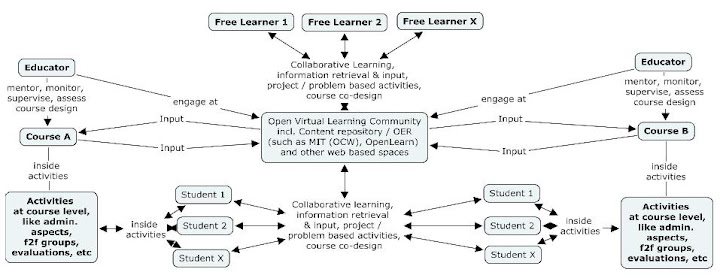
With some delay Ellen and I arrived at the session that concerned the question whether open source (OS) principles can be applied in educational settings, specifically for the creation of open content. An interesting topic introduced by researcher Andreas Meiszner of FLOSSCom. FLOSS means Free-Libre Open Source Software. His research focuses on
- Identification of factors that contribute to successful knowledge construction in informal learning communities, such as the FLOSS communities.
- Analysis of the effectiveness of FLOSS-like learning communities in a formal educational setting.
- Provision of case studies, scenarios and guidelines for teachers and decision-makers on how to successfully embed such learning communities within formal educational environments to enhance student progression, retention and achievement.
- Evaluation of the project and dissemination of the results of the project to the wider community.
| OS communities | Formal education |
|
|
| FLOSS learning in formal education | Learning from OER today |
|
|
- Quality assurance and evaluation
(for both content and learner). Some emphasized the high importance of experts, and doubted that an anarchistic OS environment for learning would enhance learning and learning resources. Others explained that - a faster feedback loop on resources and questions/problems improves quality;
- quality depends on the context of learning, hence cannot be determined for others;
- advanced rating and tagging mechanisms can be implemented to overcome some of these perceived issues;
- there is a social element of learning embedded in OS communities;
- experts (old foxes) and leaders play an important role in OS communities as well, next to roles and task assignment. (Connexions research).
- The need to meet a given curriculum, setting ground rules
- Making a metalayer or learning contexts on how to make resources and combine them, focusing less on content.
- Cultural resistance to change, and community development aspects
- Culture of learning versus accreditation. Next generation university: exam-only + external bodies for learning?
- Interface management is crucial in creating learning objects in an open source way :: "Modularity reduces the costs of coordination, but is only possible when the interfaces between the modules are clearly defined." (Understanding Open Source Communities, van Wendel de Joode 2005, p.85)
- Difference between open source and (formal) education
- Richard Heller said that there is a foundational difference between OS and OER.
Within OS is the software the end, but for education the learning process is considered more important. OER cannot be considered the end, rather the education process that surrounds it. I am not sure whether I agree with it, and not because I think that learning objects or resources are more important than the process. Rather, I think that software creation in OS communities is not an end either. People and machines in this respect can be treated in the same way: software feeds the machine to work better, educational resources feed the human machine to function better in society. - Getting passionate users in an OER community, like within OS communities
- Andreas explained the so-called "Onion Model", with 2% of the community core programmers making more than half of the code (OER: educators), and the rest of the code (45%) being made by passionate users. A third group is formed by the passive users. Andreas argues that within OER initiatives we miss this group of passionate users. We have 2% educators responsible for the content, but no tools, manuals, incentives for the users of the content to become active and passionate
contributors as well.

Week 9 readings
This post will discuss some of the books I have read this year, and which I think are relevant for the OER movement, specifically regarding economic models for sustainability. I have pointed out interesting ideas, criteria, trends, rules, issues, and concepts that can be used in education and for sustaining OER. The following literature is discussed or referred to in this post;
- The world is Flat, by Thomas Friedman
- The Long Tail, by Chris Anderson
- Democratizing Innovation, by Eric von Hippel
- New Rules of the New Economy, by Kevin Kelly
- Wealth of Networks, by Yochai Benkler
- Wikinomics, by Don Tapscott and Anthony D. Williams
- Open Innovation, by Henry Chesbrough
- The Nature of the Firm, by R.H. Coase
- Understanding Open Source Communities, by Ruben van Wendel de Joode
- Common Wisdom, by Yochai Benkler
- A Whole New Mind, by Daniel Pink
- The Future of Work, by Thomas Malone

 The first book I discuss is the "World is Flat", by Thomas Friedman. I must say that it is a disappointing read, except for some interesting examples. The writer is quite happy with himself and all the connections he has with important people around the world. It annoyed me that the book could be written in less than 100 pages without loosing much of its depth. Despite these criticisms, I think the book offers a nicely illustrated view on the globalized and interconnected economies. Lower transaction costs, improved communication channels, spurring Internet technologies, workflow software, etc. make it easier to decentralize and be more efficient.
Economic transactions are like rivers: they find the least resistance. Low-costs countries like India and China are examples of how in the past few decades they have continuously profited from globalization (according to Friedman then), by embracing the enormous outsource and offshore activities of organizations in rich countries. He warns us that activities are not confined to just simple labor, because economic opportunities have given rise to better educated individuals as well. Better educated Indian and Chinese people write software, provide online support, and undertake other less simple activities in global value chains. The money they earn is usually allocated to pay for education, and although on average, their education might not be of the same quality level as ours (what is ours?), the sheer number of people enjoying education "threatens" the Western priviliged position of having an advantage in this field, which we have always exploited it in economical terms. In combination with the lower birth rate in for example Europe, we can expect Chinese and Indian highly educated groups of people (organizations) to become intrinsically part of our high-end economies, or maybe form substitutes for it. We will and cannot battle this trend, so we must embrace it.
Intermezzo
It is a pity that the Chinese government is not democratic, protectionistic, corrupt, unconcerned with environment, etc.. This white-collar crime makes the playing field uneven, and it will be hard for us, great people of the West, to compete with it. This means we will join these networks, indulge ourselves in hardly legal activities because we do not have a choice, and make the situation even worse. Don't expect international regulation to step in.. nope, economic stakes are not to be touched. In the end, we have only ourselves to blame, I think.End intermezzo
So what about a globalized economy and Open Educational Resources? I would not just look at the OER movement, but consider education in general. I think Daniel Pink mentioned something interesting in his book "A Whole New Mind", explaining how we, as individuals and as a society, should thrive in the "conceptual age". This is an age and an economy where creators and empathizers become the cornerstones of the economy, rather than the "traditional" knowledge workers of the 20th century. He explains that some things are hard to outsource, such as design, for which both left- as right brain activities are needed. Because left-sided activities (knowledge workers) can be automated or outsourced, the left-sided activities become more important, economically and socially. Another book, "The Future of Work", by Thomas Malone, focuses more on the effects on organizations and individual employees in a future economy.
Rather than the boring and trivial "World is Flat", one should read the classic article by R.H. Coase about transaction costs economics, which is used and remixed by Yochai Benkler. Understanding this simple but ingenious economic theory, and reading the index of "The World is Flat" will provide you more with insight than reading the entire 600 pages of TWIF. In addition, I agree with Jennifer that Thomas Friedman misses the point on education;
However, instead of embracing the same connective processes and technologies that create and foster this new flat world we live in, Friedman says we must "shut off the iPod" and avoid the "instant gratification" that technology has to offer in order to prepare students for this new flat world. He spends an entire book describing countless examples of how connective technologies are flattening the world, but then recommends that students put away these technologies when they learn. Given that the thrust of Friedman's book is about embracing the factors and technologies that have created and now foster this flat world, I find it troubling that Friedman does not make the connection that these same connective processes and technologies can (and should) support education.The Long Tail (How endless choice is creating unlimited demand)

Chris Anderson supposedly coined the term "Long Tail", explaining a shift away from focus on mainstream products and markets at the head of the demand curve, and moving towards a huge number of niches in the tail. The long tail (of the demand curve) of goods and services is made possible with improved connectivity, better targeted goods and services, and little physical constraints (shelf space etc.) for distribution. Lower costs for distribution and production (music, films, etc.) allows many anyone to offer everything to anyone, a market can be created for almost any niche product. On the other hand, it does not dismiss the more traditional high-volume businesses, but it recognizes the transformation caused by the internet, and its implications for business models, such as those accompanying OER initiatives. Anderson explains the 6 themes of the Long Tail:
- In all markets, there are far more niche goods than hits;
- The costs of reaching these niches are now falling dramatically;
- More variety needs to be accompanied with filters and recommendation systems;
- The demand curve will flatten and to compensate for the newly created niche markets;
- The sum of all niches might comprise a market larger than the original 'hit' market;
- This will in the end reveal the 'real' demand curve, much more diverse than previously imaginable.
So what roles are reserved for the university then? Many, maybe even more than there are now. I think new roles will emerge, and the flexibility of the university system will determine the success of any institution. For now, I will mention a number of preliminary recommendations:
- Make educational resources attractive and of high quality, and give them away for free. That will attract people from all over the world, not only to use or change them, but additional requests are done as well. There are two ways to contribute to the value of the university's network: by giving financial input, or to contribute value in another way. The following options for revenue and contribution are deliberately described in generic terms, because there are many, many more possibilities to make money and create sustainability.
- Sources of revenue could include (i) services that concern the original author of the resource, such as teacher services (ii) additional products and services that are provided alongside the resource, (iii) contacting targeted groups within the network, (iv) customization services, (v) face-to-face happenings, (vi) assessment and accreditation, (vii) valorization of innovations, such as selling licenses and IP, and so much more...
- Sources of non-monetary contribution could include (i) improving the resources (discussing, answering questions, translating, adapting), (ii) adding resources, (iii) offering positions for learners and experts, (iv) increase network size and external visibility, (v) increase trust, etc..
- Enable flexibility in your organization by decentralizing decision making about what to learn and what to teach, about who to work with, when and where. This means all the way down to the learner!
- Enable flexibility in your system by using (and developing) open source or open standards that embrace and integrate external tools and content.

Chris Anderson claims that Karl Marx was maybe the original prophet of the Pro-Am revolution, where amateurs (better: hobbyists) and professionals work alongside each other in creating innovations, advancing science and technology, and producing cultural goods. Citizen-journalism, where amateur journalists participate in the creation of news items is just one example, but there are many more. Easier tools for production and connecting information items form the most important factor enabling this trend. Eric von Hippel describes in "Democatizing Innovation" a number of issues that relate to user-centered innovation. Without going into much depth into the content of the little book, I will discuss a number of issues that are relevant for the OER movement;
- Mass production leaves many dissatisfied, because users' needs for products and services are highly heterogenerous;
- Users provide most innovation, because they are better aware of their need and context of use (especially with "sticky information"). In addition, depending less on the principle and learning and pleasure form other incentives for users to innovate themselves rather than by the producers;
- There are different reasons for freely revealing innovations, such as reputation gain (important for academics), efficiency (from the viewpoint of both social welfare and economic rationale), network effects, and increased reuse;
- Within innovation communities the most important function is the accessibility of information. Other important criteria are that freely revealing has to be interesting, specialization, and additional functions, such as social networking and collaboration tools;
- Manufacturers can involve and make use of users by offering or selling toolkits to ease users' innovation-related tasks, produce user-developed products/provide customization, or sell ancillary products. Especially lead-users are an important group of people, from which the largest part of innovation will flow. This group needs to be fostered.
New Rules for the New Economy

Only the term "Long Tail" by Chris Anderson is new, but the ideas portrayed in the book aren't. A somewhat similar book, but less specific on the Long Tail, is "New Rules for the New Economy" by Kevin Kelly (1998). He explains the power of decentralization, connecting everything with everything, with an emphasis on understanding self-organized networks, and explains that communication is the new economy. He stresses the more active participant in the economy, instead of the passive consumer, like Alvin Toffler did decades ago. He makes a number of valid propositions to embrace the changes caused by the internet. I will not discuss them all in detail here, although they are still very interesting and true, but just point out three interesting issues:
- "Follow the Free". KK argues that by giving away something that is core of your business, you will attract more customers. You should then try to make an ancillary market for the product or service, so that you can make money and make it sustainable. This is the question being asked within the OER movement as well: we follow the free, but where is the ancillary market and what does it consist of?
- Another very relevant proposition is his argument for opening up systems: because it is open, it can interact with other systems, and acquire some of the value of these other systems. The value of a system increases with the number of systems it interacts with.
- Human attention will be the only thing being scarce in a network economy: so will the attention of students. The benefit of education is that not only students might be willing to invest time in some network if they see the benefits of contributing to it, but that an institution can also somewhat impose contribution, although this has its limits.
Wealth of Networks (How social production is transforms markets and freedoms)

According to Yochai Benkler, and me, and you, the Internet Revolution is not passé. The Internet has created new forms of individual freedom and democratic participation. It also is increasingly a medium to foster a more critical and self-reflective culture, and finally it is a mechanism to achieve improvements in human development everywhere. In "Wealth of Networks", he has taken a twist with the classic work of Scottish economist Adam Smith "Wealth of Nations". Rather than explaining the economy from viewpoints of division of labour, pursuit of self interest, and freedom of trade, Benkler argues that there an important mechanism is left out in traditional economics: social (or commons-based peer) production. He has investigated this phenomenon as a separate transaction, coming alongside the market and firm transaction, but acknowledges that it is easy to miss these changes, because
"they run against the grain of some of our most basic Economics 101 intuitions, intuitions honed in the industrial economy at a time when the only serious alternative seen was state Communism... an alternative almost universally considered unattractive today."By the way, social production can by no means be compared to communism, which stifles individualism. Social production is all about the individual, and the only egalitarian issue concerns the ability to access the relevant information.
Social production, or, as Benkler has coined it: commons based peer production, represents a new mode of social and economic production in which the creative energy of large numbers of people is coordinated into meaningful projects. Commons are the opposite of property, in the sense that law does not determine who has the authority to decide what happens to it. This doesn't mean that commons cannot be regulated, take for instance sidewalks or roads, and open to just a defined group of people.
- Within social production, the commons refer to the information belonging to it; and
- peer production relates to commons as a set of practices around commons, referring to production systems that depend on individual action. This happens mainly through the use of Internet technologies that enable fast, structured and reliable communication between people.
Why is this happening?
Social production has always been a part of our lives, but until recently the emergence of this individual and cooperative nonmarket production of information and culture is threatening the incumbents of the industrial information industries. Still, as long as governments are pursuing policies that support these incumbents, and denying the liberative force of social production, which is much more efficient in terms of social welfare, the place social production will occupy in the future economy is still at stake. The free revelation of innovations, meaning that the innovator refrains from exercising intellectual property rights and gives unlimited access to all information concerning the innovation, makes the information a public good. Making information a public good, often at one's own expense, is something that happened long before the advent of Open Source Software. In "Democratizing Innovation", Eric von Hippel sums up a number of researchers describing this phenomenon in innovation concerning mining pumping engines, medical equipment, semiconductor process equipment, library information systems, sporting equipment, and of course open source software. Just now, with cheaper communication technologies, the socio-economic playing field is facing a possibly paradigmatic shift.
Although cheaper communication makes decentralization possible and more interesting, the same argument counts for centralization. According to Thomas Malone in "The Future of Work" is centralization still is the answer in some sectors of the economy, such as semi-conductor industries, but not in all. Still, in our knowledge-based, innovation driven society, as Daniel Pink argues as well in "A Whole New Mind", the critical factors for succes are exactly the benefits of decentralized decision making; creativity, motivation, and flexibility. Benkler, similarly, mentions the allocation of the only scarce resources in our economy: on the one hand human
creativity, time, and attention, and on the other computation and communication resources.
Why this is positive
Benkler describes many positive aspects of social production, on an individual level, but also on societal/economical level. One of the important positive economical and social results of social
production, or rather, decision making in a decentralized self-organizing network concerns the allocation of capabilities/self-identification. Persons, or rather, their talents and creativity is better identified for a task in a distributed model than in a centralized hierarchy.
"Human creativity is too special and divers to standardize and therefore veryMalone puts a more narrow, but practical perspective, by saying that when people are doing things for themselves, their motivation, creativity, flexibility in response to differences in their own situation, and quality of work increases. More choices in our work makes us think about what really matters to us, human values, such as making money, spending time with friends/family, having a sense of achievement of what you do, or making the world a better place.
difficult to be specified in the contracts necessary for either market-cleared or hierarchically organized production. As the weight of human intellectual effort increases in the overall mix of inputs into a given production process, an organization model that does not require contractual specification of the individual effort required to participate in a collective enterprise, and which allows individuals to self-identify for tasks, will be better at gathering and utilizing information about who should be doing what than a system that does require such specification."
More people have more freedom, and more and more people are becoming wealthier, the whole range of human values are becoming more important, not just the economic ones. Organizations now have to address this wider range of human values, enabling a market not just based on economical rules, but on human values. Information and communication technologies will make this better possible, and more likely to occur, because it is much easier to find a critical mass of people to do these things.
Social production and its relation to working
As said, social production depends on individual action. Individuals choose their tasks, and contribute without any hierarchical interference in a decentralized network. Thomas Malone, although concerned mainly with financial compensation for action in such a free market and the role of companies, provides a similar view in "The Future of Work", by stating that we are in the early stages of a change towards human freedom in business, and comparing this change in businesses with the introduction of democracy into politics. He justifies this grand statement by saying that now it is possible to have both the human benefits of a small organization, such as freedom, flexibility, creativity, and motivation, and the advantages commonly available for
just large organizations, such as economies of scale and knowledge. As mentioned before, the reduction of costs of communication because of information technologies forms the basis of this enhancement. Persons can now make sensible decisions rather autonomously, because information to make these decisions, and the technology to discuss this information is available at their fingertips. Benkler also assumes that social production will create the perfect match between task and person.
Social production and its relation to learning and OER
Between social production and learning some important analogies can be drawn with learning trends and theories, such as DIY, communities of practice, lifelong learning, networked learning or connectivism. In his article about the peer production of educational resources "Common Wisdom", Benkler focuses specifically on the creation of content resources. I would rather extend the focus on collaboratively creating a learning web, where rules and mechanisms are created collaboratively, learning contexts in addition to learning content. In "Wealth of Networks", he describes a number of criteria and rules for that apply for social production of any kind.
Criteria and characteristics
First of all, an important statement about peer production concerns the role of leaders. Leadership is important, but never authorative. Benkler (and others) describe some rules and criteria for fosteringsocial production:
- Information production must be ubiquitously distributed, meaning that all inputs must be under the control of individual users.
- There are two imperatives for harnessing the excess capacity of humans (in the form of creativity, time and attention). Social production exists of a large number of people working on their own on a small piece of an entire project. Their contributions vary widely in quality, quantity, focus, geographic location, and timing. Successful social production projects have shown a remarkable ability to to pool these higly diverse efforts effectively by being modular in structure, and composed of highly granular pieces.
- "Modularity" is a property of a project that describes the extent to which it can be broken down into smaller components, or modules, that can be independently produced before they are assembled into a whole. Modularity reduces the costs of coordination, but is only possible when the interfaces between the modules are clearly defined. (van Wendel de Joode 2005, p.85)
- "Granularity" refers to the size of the modules, in terms
of the time and effort that an individual must invest in producing
them.
- "Modularity" is a property of a project that describes the extent to which it can be broken down into smaller components, or modules, that can be independently produced before they are assembled into a whole. Modularity reduces the costs of coordination, but is only possible when the interfaces between the modules are clearly defined. (van Wendel de Joode 2005, p.85)
- The social production efforts and cooperation are maintained by a number of constituents:
- Technical architecture
- Social norms and values
- Legal rules
- Technically backed hierarchy (validated by social norms)
- Technical architecture
Wikinomics (How mass collaboration changes everything)

Don Tapscott and Anthony Williams refer to Benkler in "Wikinomics" to back up their argument that we are changing into new forms of mass collaboration. They describe peer production as the open collaboration between lots of people and firms to drive innovation and growth in industries.
"Billions of connected individuals can now actively participate in innovation, wealth creation, and social development in ways we once only dreamed of. And when these masses of people collaborate they collectively can advance the arts, culture, science, education, government, and the economy in surprising but ultimately profitable ways. Companies that engage with these exploding Web-enabled communities are already discovering the true dividends of collective capability and genius."Tapscott and Williams use a number of interesting case studies to explain different ways of how companies nowadays have embraced the collaborative power of all connected individuals. They explain that companies should find the right combination between incorporating external ideas and knowledge, with internal efiiciency and core knowledge, following the paradigm coined 'open innovation' by Henry Chesbrough (2003). I will post something about the changing relationships regarding employment and work in a separate post, but want to highlight one specific issue that I find extremely interesting in the book, because it can be a means for sustainaing OER.
Ideagoras
Ideagoras are social marketplaces connecting the innovative ideas of individuals with the needs of (commercial) organizations. A great example of an ideagora is the website InnoCentive, where amateurs and professionals around the world can connect to solve problems, and organizations can use the collective intelligence of all these distributed individuals. Basically, the website hosts scientific challenges to which participants around the world can respond. These participants, being students, scientists and hobbyists (anyone), use their unique ideas and approaches to solve these problems and get rewarded for it. You can consider it a global R&D lab. Not only is it possible to connect problems with solutions, but it also is possible to do it the other way around. Imagine a company or individual with ideas and patents that may be very useful in other sectors.
Websites like Nine Sigma offer not only the possiblity of posting problems on which people can
respond, but also a marketplace where ideas and patents are transferred to anyone interested. One is the idea searching for a problem, and the other is the problem searching for an idea. You can imagine that in an OER environment, these two possibilities should be represented as well in order to create a thriving community where no idea or problem is left behind. My interest for this type of valorizing knowledge is that it can have a number of positive consequences:
- It may form incentives for learning, because solving real-life problems can be both fun and rewarding;
- It can also constitute an input for creating or remixing educational resources, or the result of the problem solving results in new educational resources that can be used and reused;
- The value of education and educational resources is seen immediately because of its application within society/economy;
- Such a platform creates effervescence and viability because people can form networks to solve problems collaboratively, and it offers a platform for individuals to make value out of their ideas. Etienne Wenger, amongst others, have researched the fact that experts in a field spontaneously form interest groups that communicate to exchange their views and learnings on how to carry out and improve the practices of their profession, similar to how participants in open source communities do that.
Wrap-up
This post has been quite voluminous again. I hope I have used headings and bullets well, so people without much time can skim through it. I have tried to take ideas that are described in different books treating socio-economical subjects, and bring these in an OER-context. In some future postings, I might describe another set of ideas that can make OER initiatives sustainable, but this will do for the moment.
Feb 8, 2007
Introduction
This blog post introduces the concept on which I will be working on the coming period. Please join my project if you believe in it. Leave a comment, and I will contact you by the time the research website is ready.
Educational traditions, professional development, sociopolitical changes, and technological innovations do not match today and create a gap between graduated engineer and dynamic corporation. The Read/Write Web and numerous online initiatives, such as the Open Educational Resources (OER) initiative, have created endless possibilities for connecting to resources, sharing knowledge, and learning. Traditional learning structures are under great pressure because of these new opportunities. Besides, old-fashioned degrees do not match anymore with the needed competencies of the modern dynamic service companies. A shift is occurring from university as authority towards the network as an authority for learning. The Internet also provides numerous new ways for employment, through online marketplaces, and innovation, happening in open communities.
By combining these technologies and trends an environment can be created where people learn by increasing the value of their environment, by sharing resources and knowledge. By doing this they increase their value in the network, their online identity, which leads to job opportunities (a sort of personal ROI). Employers can connect to people using specific search terms, and judge a person’s reliability with its online identity, which in turn is the result of his/her online activities evaluated by others. Innovation in such an environment happens distributed and in an open way, partly shifting the subject of competitiveness from organization to person.
Although the information will be available for different competing organizations, and so cannot be the source of competition, the costs of innovation are distributed in the innovation network as well, creating possibilities for competing on other issues. Innovation happening within a certain closed environment as a company (or research on a university), is less advantageous because of the intrinsic advantages of innovation happening in a network, such as faster dissemination of knowledge, lower investments in innovation, and ‘more eyeballs' (making all bugs shallow). In such an environment, people will be the subject of competition, and sharing resources, helping other people, and enhancing the value of your network will be the activity. Organizations will compete by managing these people as effective and efficient as possible, and by being able to find and apply the information created in these networks as fast as possible. An example of this can be found within IBM, which is making billions of dollars from the innovation happening within Open Source Software communities.
An essential note regards the focus of the research. I am personally involved in the OpenER project of Delft University of Technology (DUT). This project, just like many of its fellow (OER) initiatives globally, lacks a model for sustainability. Almost all of OpenER projects around the world depend heavily on funding for setup, and this does not seem to subside after implementation (they still need significant funds to keep these projects running). Now here is the gap, and at the same time the research focus. By applying the above mentioned concept, but focusing on DUT, or maybe the whole IDEA league, a sustainable model for this specific OpenER can be created. More elaborate: an environment will be investigated/designed where students can interact with teachers and each other. They can also learn from the available resources, which they can alter the way they like, and improve. Of course, the question: why would I put effort in improving a certain course, in providing feedback on a student’s question, write an extensive review on a book, initiate a research, or make any other effort? Well, here economical mechanisms of the concept step in: organizations should be involved, creating financial incentives, employment, and ideas for research. Students, free in sharing knowledge, wanting to demonstrate and improve their skills, can do this by being active in one or more a communities. Companies want students to link up with students, have them do projects, investigate issues, and more. This provides for them a perfect environment to do that because it involves an online marketplace for flexible employment. All mentioned issues and assumptions need thorough investigation during the thesis research.
Subscribe to:
Posts (Atom)


